NIME 2026 Workshop
It's Play NIME
Mapping Playfulness in NIME
LDN 2.05 - Loughborough University of London East Campus,London, UK & Online
09:00 - 13:00 Tuesday, 23 June 2026
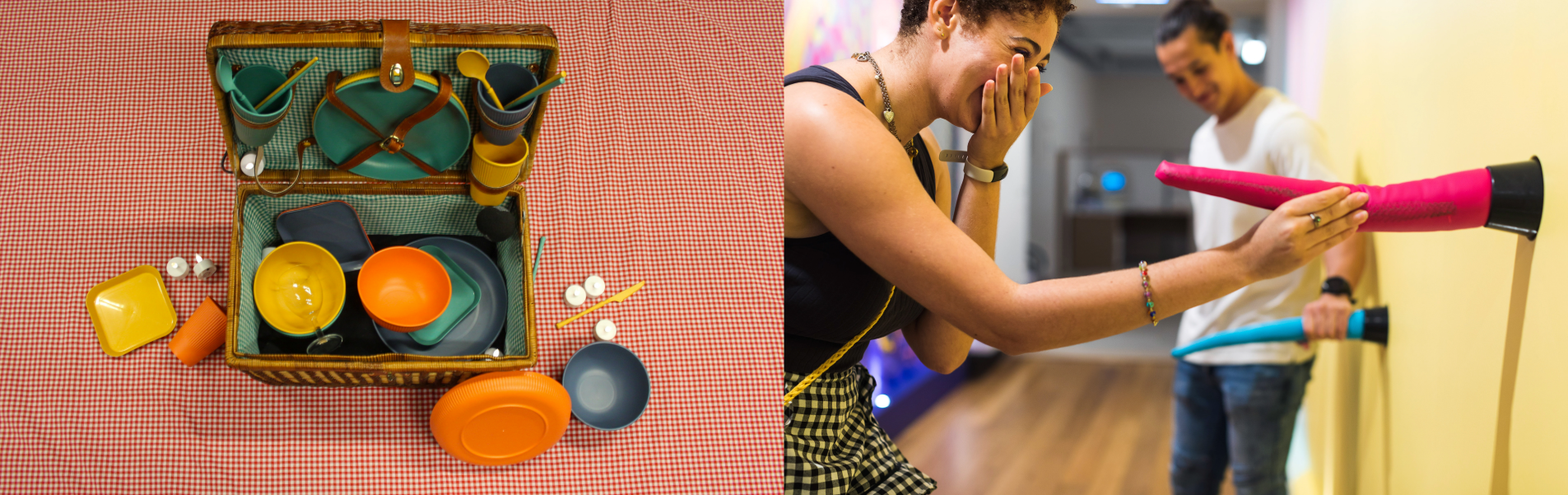
Playfulness in NIME
The NIME community frequently uses the terms "playful" to describe their works, yet lacks consensus on what playfulness means in this context. Existing NIME research draws from different play frameworks, with some works emphasising providing flow states, and others focusing on appropriation and subversion. This workshop brings together artists and researchers in the community to collectively address this conceptual ambiguity. Through a participatory approach, we aim to explore together the diverse understandings of playfulness in NIME and strengthen the network among researchers and practitioners interested in the topic.
Official Sign Up
Join us for this exciting workshop on playfulness in NIME. Register your spot now! (Deadline 19th June)
Sign Up →Participant Form
Already signed up? Please fill out this short form to help us prepare better for you.
Fill Form →Evening Workshop
Interested in more? Join the workshop on Playfulness and AI in the evening!
Learn More →Call for participation
Artists, designers, researchers, musicians, and creative practitioners at NIME who are interested in play and playfulness for music interfaces, who wish to learn more about these topics, or who are actively contributing knowledge in this area, are invited to participate in this workshop examining playfulness in NIME. Although "playful" and "playfulness" are frequently referenced in NIME literature to describe interfaces, experiences, and interactions, there is little discussion of how the NIME community experiences play. In the workshop, we will explore playfulness through group ideation and discussion. We encourage prospective attendees to submit a short abstract or video of their approach to play if they wish to present during the workshop. Our session will also include a Show & Tell session in which attendees are invited to share their NIMEs.
Workshop Plans
Part 1: Introduction
The workshop will open with a warm-up activity to help participants get to know one another and encourage engagement throughout the workshop. We will then introduce key concepts of and frameworks for playfulness, followed by presentations from participants who have pre-submitted their approaches to play. Participants will present individual perspectives on approaches to play and on how playful approaches can be incorporated into both the design and performance of NIME, providing a background to stimulate discussion.
Part 2: Collective ideation and group work
All participants will engage in a structured ideation session focused on mapping playfulness within NIME, employing the 1-2-4-All discussion method. This approach is designed to foster active participation by progressing through a series of stages: participants ideation individually, then collaborate in pairs, followed by discussion in groups of four. In the final stage, each group of four shares their outcomes with the larger group, facilitating collective reflection and synthesis. Following the collaborative mapping of playfulness within NIME, participants will be organised into groups. Each group will select a specific aspect identified during the ideation process and propose design and research approaches that may foster that dimension of playfulness
Part 3: Discussion, Show & Tell and networking
Participant groups will present their approaches to playfulness and discuss them with the other participants. We will then wrap up the discussion and facilitate an informal Show & Tell session for participants to share their creative playful work. The session will finish with time for networking.
Workshop Structure
| Time (UTC+1) | Activity | Duration |
|---|---|---|
| 09:00 | Welcome &Warm-up exercise | 20 mins |
| 09:20 | Presentations from participants | 35 mins |
| 09:55 | Presentation on Playfulness | 15 mins |
| 10:10 | Break | 15 mins |
| 10:25 | 1-2-4-All Ideation activity (x2) | 30 mins |
| 10:55 | Mapping playfulness | 30 mins |
| 11:25 | Break | 15 mins |
| 11:40 | Mapping playfulness in NIME | 30 mins |
| 12:10 | Closing comments | 10 mins |
| 12:20 | Show & Tell | 20 mins |
| 12:40 | Networking | 20 mins |
About the organisers
Lucía Montesinos [she/her] is a creative technologist and design researcher, currently a PhD fellow at the IT University of Copenhagen. Her practice-based research engages with HCI and NIME, exploring how technology can invite us to participate, create, play, and pay attention to the world around us, with a current focus on designing playful musicking experiences.
Tara Pattenden [she/her] is an instrument developer, performer and artist working with malleable technologies for interactive installations and participatory performance. She is currently a PhD candidate the Queensland Conservatorium, Griffith University where her project explores how craft based, wearable and tactile instruments can enhance participatory performance for playful co-collaborative creative experiences.
Lia Mice [she/her] is an award-winning mixed media artist of oversized sculptural musical instruments, educator and live performer. For over 20 years, Mice has prolifically produced a diverse body of work, frenetically shape shifting through multidisciplinary practices and international music and art scenes. At the core of her creative approach is a joyful DIY ethic: creating with what she has, without waiting for resources or permission.
Contact
For any questions about the workshop, please contact Lucía at lumo@itu.dk